Dublin, Ireland – 13th May 2026
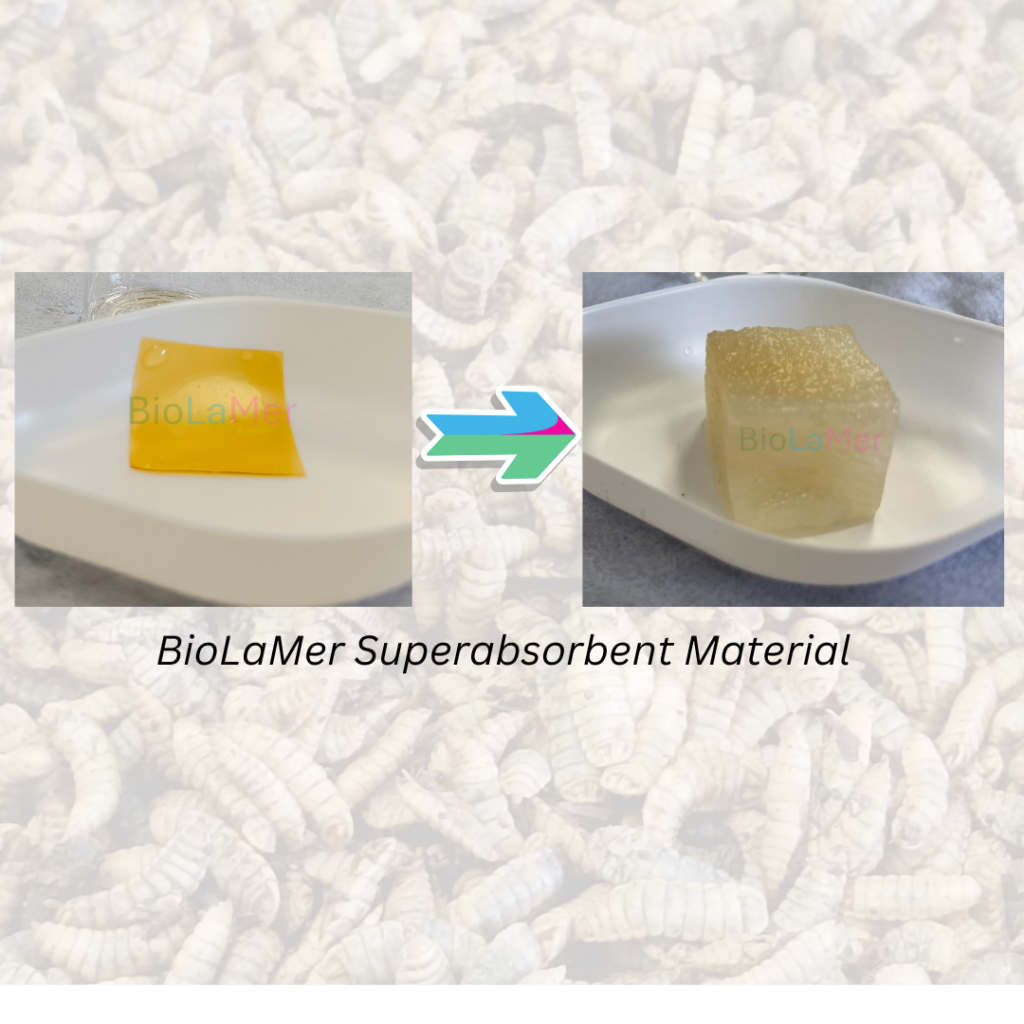
The BioLaMer project, funded by the European Innovation Council (EIC) Pathfinder Open programme has announced a significant breakthrough in the development of next-generation bio-based superabsorbent materials (SABs), delivering a sustainable and high-performance alternative to conventional petroleum-derived absorbents.
Using an innovative insect-based biorefinery approach powered by Black Soldier Fly larvae (Hermetia illucens), the technology converts organic waste streams into functional biopolymers, which are further engineered into high-value composite absorbent materials. These bio-based superabsorbents exhibit exceptional absorption capacity and performance, making them suitable for applications in hygiene products, agriculture, and environmental management.
A major milestone in this development is the demonstrated full biodegradability of the materials. Validation studies confirm that these superabsorbents significantly reduce microplastic generation compared to traditional absorbent products, reinforcing their environmental advantages and supporting the shift toward a circular bioeconomy.
The innovation also shows strong commercial promise. A patent application has been filed covering both the composition and production methods of the superabsorbent biopolymers, paving the way for industrial adoption and market deployment.
“This technology shows how we can turn everyday waste into advanced, high-performance materials that are both useful and environmentally responsible,” said Dr. Sibu Padmanabhan, project coordinator. “In simple terms, we are taking something that would normally be discarded — like food waste — and transforming it into a material that can absorb liquids efficiently and then safely break down after use, without leaving harmful residues behind. This is a practical step toward reducing plastic pollution while still meeting the needs of modern products.”
This breakthrough highlights the growing potential of bio-based materials to replace fossil-derived products, offering scalable and sustainable solutions across multiple sectors.
“From a practical standpoint, this technology is about rethinking waste as a resource,” said Prof. Michael Morris, Principal Investigator. “What we have developed is a way to take organic waste and convert it into a material that can absorb and retain large amounts of liquid — similar to what you find in everyday items like nappies or agricultural water retainers — but without the long-term environmental cost. For the general public, the key benefit is simple: these materials perform effectively during use and then naturally break down afterward, helping to reduce the accumulation of persistent plastics in our environment. It’s a clear example of how sustainable science can deliver solutions that fit seamlessly into daily life while addressing a major environmental challenge.”
For more information on the BioLaMer project and its outcomes, please visit CORDIS website, and follow our official page https://biolamer.eu or contact the team at biolamerp@gmail.com.
Prepared by: SocLineTech Solutions & Services (CDE Partner)
Press Contact
Dr Sibu Padmanabhan (Project Coordinator)
Email: chullans@tcd.ie; email@soclinetech.ie
Contact no. +353 1 896 4246; +353 87 096 7678
Funding Acknowledgment
This project is funded by European Innovation Council under Grant Agreement no. 101099487. Views and opinions expressed are however those of the author(s) only and do not necessarily reflect those of the European Union. Neither the European Union nor the granting authority can be held responsible for them.